
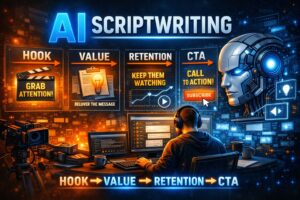
Creators who learn to use AI for video scripts gain a massive advantage: they stop writing linearly and start designing emotional architecture — Hook → Value → Retention → CTA — with AI as a true co‑author.
This chapter shows how to build scripts that hold attention, deliver value, and convert viewers.
1. Hook: Capturing Attention with AI
The first 5 seconds decide everything. AI helps you test and refine hooks faster than any brainstorming session.
Using AI for video scripts, you can generate multiple hook variations, test emotional tones, and match platform‑specific pacing.
How AI helps:
- Generates multiple hook variations for the same topic.
- Analyzes which emotional tone fits your audience (curiosity, shock, empathy, humor).
- Suggests rhythm and phrasing that match platform algorithms (YouTube, TikTok, Shorts).
Example:
Prompt to AI:
“Generate 5 hooks for a video about why cinematic editing hurts retention.”
AI might return:
- “Your cinematic edits are killing your channel — here’s why.”
- “Stop editing like a filmmaker — start editing like a storyteller.”
- “Beautiful videos, zero views? Let’s fix that.”
You choose the one that fits your voice — AI just accelerates the discovery.
2. Value: Structuring the Core Message
Once the hook works, the viewer expects clarity and payoff. AI helps you organize ideas and build logical flow.
How AI helps:
- Turns raw notes into structured sections.
- Suggests transitions between ideas.
- Highlights missing context or weak arguments.
- Generates analogies and examples to make abstract points tangible.
Example:
Prompt:
“Turn these bullet points into a clear 3‑part structure with emotional progression.”
AI output:
- Problem — why creators lose retention.
- Insight — how editing rhythm affects attention.
- Solution — how to fix pacing using AI analytics.
You refine tone and rhythm — AI gives the skeleton.
3. Retention: Keeping Viewers Engaged
Retention is not about tricks — it’s about emotional pacing. AI can analyze your script’s rhythm and predict drop‑off points.
How AI helps:
- Detects long monologues or low‑energy sections.
- Suggests where to insert visuals, questions, or emotional beats.
- Simulates viewer attention curve.
Example:
Prompt:
“Analyze this script and mark where audience attention may drop.”
AI output:
- Drop at minute 1: too much exposition.
- Drop at minute 2: no visual change.
- Suggest: add question or cutaway.
You adjust — AI becomes your retention analyst.
4. CTA: Turning Attention into Action
The call‑to‑action is not a command — it’s a continuation of the story. AI helps you craft CTAs that feel natural, not forced.
How AI helps:
- Suggests CTA phrasing based on tone (educational, emotional, humorous).
- Tests variations for conversion potential.
- Aligns CTA with the emotional arc of the video.
Example:
Prompt:
“Generate 3 CTAs for a video ending about creative burnout.”
AI output:
- “If this hit home, subscribe — we’re building a space for creators who refuse to burn out.”
- “Join the next episode — we’ll turn burnout into creative flow.”
- “Hit subscribe if you’re done fighting algorithms and ready to build systems.”
You choose the one that matches your authenticity.
5. Workflow: AI as Your Script Co‑Author
Here’s how creators will write in 2026–2030:
- Idea input — seed topic or insight.
- AI expansion — generate hooks, outlines, emotional arcs.
- Human refinement — adjust tone, rhythm, authenticity.
- AI validation — check clarity, pacing, retention.
- Final polish — human voice, emotion, imperfection.
AI becomes your creative mirror — not your replacement.
6. Why Human Structure Still Wins
AI can write, but it cannot feel. It can predict engagement, but not meaning. It can simulate emotion, but not experience.
That’s why the best scripts will be AI‑assisted, human‑anchored. The machine builds the frame — you fill it with life.
7. The Future of Scriptwriting
By 2030, creators will design scripts like engineers design systems:
- Hook = trigger
- Value = data
- Retention = feedback loop
- CTA = conversion node
But the soul of the story will remain human. AI will handle structure — you’ll handle truth.
For a broader industry perspective, see this external analysis of how AI is reshaping video production workflows and accelerating the shift toward automated filmmaking.
“AI in Creative Production” Series
- Part 0: AI and the Collapse of Traditional Video Production: What Creators Need to Know in 2025–2030
- Part 1: AI for Ideas and Topic Research: How Creators Can Use AI to Generate Topics, Validate Demand, and Find Unique Angles
- Part 2: AI for Scriptwriting and Story Structure: How to Build Hooks, Flow, and Retention with AI as Your Co‑Author (current article)
- Part 3: AI for Video Creators: Preparing for a Shoot with Storyboards, Shot Lists, Checklists, and Smart Prompts
- Part 4: AI for Editing: Automating Cuts, Music, Rhythm, Subtitles, and B‑roll in 2026
- Part 5: AI for Visuals: Thumbnails, Infographics, Styling, Frames, and Illustrations in 2026
- Part 6: AI for Voice and Audio
- Part 7: AI for Analytics and Channel Growth
- Part 8: AI as Your Personal Producer
- Part 9: Shorts with AI: From Viral Idea to Final Cut
- Part 10: AI Animation: From Static Frame to Motion
- Part 11: AI for 3D Modeling — Generating Objects, Textures, and Environments
- Part 12: AI for Simulation — Generate Worlds, Physics & Behaviors
- Part 13: AI for Motion Design: Titles, Transitions, and Visual Effects
- Part 14: AI for Cinematic Production — Integration with Editing and Sound