
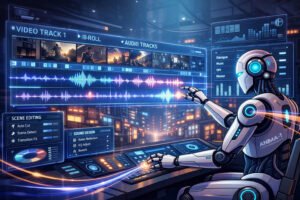
AI cinematic production is transforming modern filmmaking by integrating intelligent editing, automated sound cleanup, adaptive mixing, and AI‑generated scoring into a unified workflow. Artificial intelligence is no longer a side tool — it has become a core component of cinematic production, enhancing both video and audio pipelines.
This article explores how AI enhances cinematic workflows, how it integrates with editing and audio, and what tools define the new era of film production.
1. What “Cinematic AI” Actually Means
Cinematic AI is not about replacing directors or editors. It is about augmenting the production pipeline:
- accelerating editing
- automating sound cleanup
- generating temp music
- enhancing dialogue
- creating transitions and VFX
- improving color and tone consistency
- assisting with narrative pacing
AI becomes a co‑pilot for editors and sound designers, handling technical tasks so humans can focus on storytelling.
2. AI Integration with Video Editing
2.1. Automated Rough Cuts
AI can analyze footage and assemble a rough cut based on:
- best takes
- emotional tone
- continuity
- script alignment
- pacing preferences
Tools like Adobe Premiere Pro (Sensei), DaVinci Resolve Neural Engine, and Descript already perform:
- silence removal
- filler word removal
- multi‑camera sync
- scene detection
- auto‑jump cuts
This reduces hours of manual work to minutes.
2.2. Cinematic Transitions and Motion Effects
AI generates:
- seamless scene transitions
- camera movement simulation
- dynamic zooms
- warp and morph effects
- cinematic motion blur
- AI‑driven match cuts
Runway Gen‑2 and Pika Labs can even create AI‑generated transition shots to bridge scenes stylistically.
2.3. Color Grading Assistance
AI helps with:
- automatic color matching between shots
- skin tone correction
- LUT generation based on reference frames
- mood‑based grading (“Blade Runner”, “Wes Anderson”, “Noir”)
DaVinci Resolve’s Neural Engine is currently the strongest in this domain.
3. AI Integration with Sound Design
Sound is half the cinematic experience — and AI is revolutionizing it.
3.1. Dialogue Enhancement
AI can:
- remove background noise
- restore damaged audio
- isolate voices
- fix plosives and sibilance
- match dialogue tone across takes
Tools: Adobe Enhance Speech, iZotope RX AI, Auphonic.
3.2. Automatic Sound Mixing
AI can mix:
- dialogue
- music
- ambience
- sound effects
…based on cinematic standards (dialogue‑first mix, broadcast mix, theatrical mix).
It adjusts:
- EQ
- compression
- loudness
- stereo width
- ducking
This is especially powerful for indie creators.
3.3. AI‑Generated Sound Effects
AI can generate:
- footsteps
- ambience
- sci‑fi effects
- impacts
- transitions
- whooshes
- drones
Tools: ElevenLabs Sound Effects, Krikey AI Audio, Stable Audio.
3.4. Temp Music and Score Generation
AI can create:
- orchestral beds
- emotional cues
- tension drones
- trailer hits
- rhythmic pulses
Tools: Suno, AIVA, Soundraw, Beatoven.ai.
This is ideal for pre‑visualization, trailers, and early edits.
4. AI‑Driven Cinematic Workflow (2026 Pipeline)
Here is how modern creators integrate AI into a full cinematic pipeline:
Step 1 — Ingest & Sync
AI syncs multi‑cam footage, cleans audio, detects scenes.
Step 2 — Rough Cut
AI assembles a first cut based on best takes and pacing.
Step 3 — Motion & Transitions
AI generates transitions, motion graphics, and VFX inserts.
Step 4 — Sound Cleanup
AI enhances dialogue, removes noise, restores damaged audio.
Step 5 — Temp Score
AI generates placeholder music to define emotional tone.
Step 6 — Color Matching
AI applies LUTs, fixes skin tones, matches lighting.
Step 7 — Final Mix
AI balances dialogue, music, and effects to cinematic standards.
Step 8 — Human Polish
Editor and sound designer refine the final cut.
AI does the heavy lifting. Humans do the storytelling.
5. Tools That Define AI Cinematic Production
Editing & Video AI
- Adobe Premiere Pro (Sensei)
- DaVinci Resolve Neural Engine
- Descript
- Runway Gen‑2
- Pika Labs
- Luma AI
Sound AI
- iZotope RX
- Adobe Enhance Speech
- Auphonic
- ElevenLabs SFX
- Stable Audio
Music AI
- Suno
- AIVA
- Soundraw
- Beatoven.ai
6. Limitations of AI in Cinematic Production
AI is powerful, but not perfect:
- cannot understand emotional nuance like a human
- struggles with complex narrative pacing
- may produce generic music without strong motifs
- cannot replace a sound designer’s creative intent
- requires human supervision for final polish
AI is a tool — not a director.
7. The Future of AI in Cinematic Production
Over the next 3–5 years, expect:
- full AI‑assisted editing timelines
- AI‑generated establishing shots
- AI‑driven Foley libraries
- real‑time dialogue replacement
- adaptive scores reacting to scene emotion
- automated cinematic color pipelines
- AI‑powered story pacing suggestions
Cinematic production will become faster, more accessible, and more creative.
Conclusion
AI is transforming cinematic production by integrating deeply with editing and sound. It automates technical tasks, accelerates workflows, and expands creative possibilities — while leaving storytelling in human hands.
The future of filmmaking is hybrid: human creativity + AI precision.
For a broader industry perspective, see this external analysis of how AI is reshaping video production workflows and accelerating the shift toward automated filmmaking.
“AI in Creative Production” Series
- Part 0: AI and the Collapse of Traditional Video Production: What Creators Need to Know in 2025–2030
- Part 1: AI for Ideas and Topic Research: How Creators Can Use AI to Generate Topics, Validate Demand, and Find Unique Angles
- Part 2: AI for Scriptwriting and Story Structure: How to Build Hooks, Flow, and Retention with AI as Your Co‑Author
- Part 3: AI for Video Creators: Preparing for a Shoot with Storyboards, Shot Lists, Checklists, and Smart Prompts
- Part 4: AI for Editing: Automating Cuts, Music, Rhythm, Subtitles, and B‑roll in 2026
- Part 5: AI for Visuals: Thumbnails, Infographics, Styling, Frames, and Illustrations in 2026
- Part 6: AI for Voice and Audio
- Part 7: AI for Analytics and Channel Growth
- Part 8: AI as Your Personal Producer
- Part 9: Shorts with AI: From Viral Idea to Final Cut
- Part 10: AI Animation: From Static Frame to Motion
- Part 11: AI for 3D Modeling — Generating Objects, Textures, and Environments
- Part 12: AI for Simulation — Generate Worlds, Physics & Behaviors
- Part 13: AI for Motion Design: Titles, Transitions, and Visual Effects
- Part 14: AI for Cinematic Production — Integration with Editing and Sound (current article)