
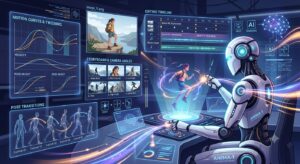
1. Why AI Animation Became the New Standard
Animation is no longer expensive or slow. AI Animation is rapidly becoming the new standard in creative production. AI now performs tasks that previously required a full team:
- generates motion from a single frame
- transfers gestures and facial expressions from real video
- creates animation from text prompts
- assembles scenes automatically
- renders in seconds instead of hours
This isn’t “toy tech” — it’s a new production paradigm: fast, flexible, accessible.
2. How AI Helps You Develop Animation Concepts
Animation starts with a concept, not with movement. AI fully covers the ideation stage:
- story generation (short, visual, easy to animate)
- visual conflicts (contrast, paradox, metaphor)
- trend adaptation for animated formats
- moodboards and visual references
Tools: ChatGPT, Claude, Perplexity, Midjourney, Ideogram.
3. How AI Generates Motion from a Single Image
This is the breakthrough.
AI can:
- animate a character from one static image
- transfer motion from real footage
- generate smooth transitions between poses
- create movement from text (“the character walks,” “the car turns”)
- produce looped animations for social media
Tools: Runway Gen‑3, Pika 2, AnimateDiff, Viggle, Luma Dream Machine.
4. Motion Transfer: When AI Copies Your Body Language
Motion transfer allows AI to replicate:
- gestures
- facial expressions
- poses
- body dynamics
- movement style
from your video onto any character or object.
This enables:
- animation in your personal style
- branded characters
- animated avatars for shorts and reels
- explainer videos without filming
5. How AI Helps with Storyboarding and Directing
AI turns text into a visual plan:
- storyboard
- composition
- camera angles
- camera movement
- timing of each shot
- transitions between scenes
You write: “The character enters the room, the camera tilts down slightly, cold lighting.” AI outputs 6–12 frames with precise visual logic.
Tools: ChatGPT, Claude, Midjourney, Ideogram.
6. How AI Assembles Animation in Editing
Editing is traditionally the most painful part. AI automates it:
- auto‑scene assembly
- auto‑transitions
- auto‑rhythm
- auto‑sound design
- auto‑music
- auto‑subtitles
- auto‑color grading
Animation becomes a fast creative process instead of a technical struggle.
Tools: Runway, Pika, Descript, Vrew, CapCut AI.
7. How AI Creates Animation for Shorts and Reels
Animation is perfect for short‑form content:
- bold movement
- strong contrast
- fast transitions
- visual paradoxes
- meme‑like characters
AI helps you:
- generate 10 hook variations
- compress scripts to 7–12 seconds
- tighten rhythm
- adapt animation to vertical format
- optimize for retention
8. How AI Analyzes Animated Videos After Publishing
AI reveals:
- retention
- drop‑off points
- successful movements
- scenes that “hit”
- visual elements that work
- recommendations for the next batch
Tools: ChatGPT Vision, vidIQ, TubeBuddy.
9. How to Build a System: 5 Animated Videos in One Evening
Combine all steps:
- ideas → 10 minutes
- storyboard → 10 minutes
- motion generation → 20 minutes
- editing → 20 minutes
- publishing → 10 minutes
Total: 5 animated videos in one evening — no rendering farms, no manual rigging, no complex software.
For a broader industry perspective, see this external analysis of how AI is reshaping video production workflows and accelerating the shift toward automated filmmaking.
“AI in Creative Production” Series
- Part 0: AI and the Collapse of Traditional Video Production: What Creators Need to Know in 2025–2030
- Part 1: AI for Ideas and Topic Research: How Creators Can Use AI to Generate Topics, Validate Demand, and Find Unique Angles
- Part 2: AI for Scriptwriting and Story Structure: How to Build Hooks, Flow, and Retention with AI as Your Co‑Author
- Part 3: AI for Video Creators: Preparing for a Shoot with Storyboards, Shot Lists, Checklists, and Smart Prompts
- Part 4: AI for Editing: Automating Cuts, Music, Rhythm, Subtitles, and B‑roll in 2026
- Part 5: AI for Visuals: Thumbnails, Infographics, Styling, Frames, and Illustrations in 2026
- Part 6: AI for Voice and Audio
- Part 7: AI for Analytics and Channel Growth
- Part 8: AI as Your Personal Producer
- Part 9: Shorts with AI: From Viral Idea to Final Cut
- Part 10: AI Animation: From Static Frame to Motion (current article)
- Part 11: AI for 3D Modeling — Generating Objects, Textures, and Environments
- Part 12: AI for Simulation — Generate Worlds, Physics & Behaviors
- Part 13: AI for Motion Design: Titles, Transitions, and Visual Effects
- Part 14: AI for Cinematic Production — Integration with Editing and Sound