
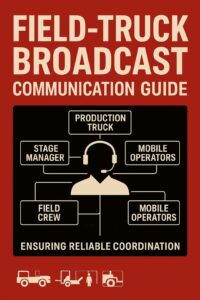
In live productions, field–truck communication becomes a complex, multi‑layered system. When part of the team works on the field, and another part operates from the production truck, clarity and reliability directly affect reaction speed, shot quality, team safety, and the ability to handle unexpected situations.
- reaction speed
- shot quality
- team safety
- the ability to handle unexpected situations
This article outlines the key principles and protocols that help maintain stable communication between field crews and the production truck in any environment.
1. Primary Channels in Field–Truck Communication
Communication typically relies on several parallel channels:
1. Intercom (primary channel)
Used for:
- director’s commands
- camera coordination
- audio communication
- managing transitions
2. Walkie‑talkies (backup and mobile channel)
Essential for:
- assistants
- stage managers
- mobile camera operators
- large or multi‑zone venues
3. Visual signals
When audio is unavailable:
- tally lights
- hand signals
- light cues
4. Messaging apps
Used for:
- sending files
- off‑air clarifications
- remote participants
These channels form the backbone of stable field–truck communication.
2. The Stage Manager as the “Bridge” Between Field and Truck
The stage manager is the key link who:
- receives commands from the director
- relays them to the field team
- confirms readiness of talent and crew
- monitors safety
- coordinates movement of people and equipment
They act as the “local director” on the field.
3. Communication Protocols for Mobile Camera Operators
Mobile operators are the most vulnerable to communication issues. To avoid chaos:
- commands must be short and pre‑agreed
- operators confirm only critical instructions
- if communication is lost, the operator switches to predictable fallback behavior
Examples of predictable behavior:
- returning to a predefined position
- switching to a wide, stable shot
- holding a safe, steady frame
Predictable fallback behavior is essential for safe field–truck communication during mobile operations.
4. Working in Low‑Signal or Unstable Environments
Outdoor locations, crowds, and sports venues often create communication challenges. To minimize risks:
- use dual‑channel communication (intercom + walkie‑talkie)
- assign a backup operator
- predefine fallback shots
- test communication in all zones of the venue
If communication fails completely:
- the operator follows the pre‑agreed scenario
- the stage manager takes local control
- the truck switches to a safe shot
5. Standardized Commands for Both Field and Truck
To avoid misunderstandings, commands must be consistent across the entire team:
- “Start”
- “Stop”
- “Ready”
- “Live”
- “Transition”
- “Move back”
- “Repeat”
The fewer variations, the fewer mistakes.
6. Safety as a Communication Priority
Field environments always involve risks:
- cables
- tripods
- crowds
- vehicles
- stage structures
Safety commands must be:
- loud
- unambiguous
- prioritized
Examples:
- “Stop movement!”
- “Cable underfoot!”
- “Operator, step back!”
Safety always comes before the shot.
7. Post‑Show Review
After the broadcast, it’s important to:
- analyze where communication failed
- highlight what worked well
- update protocols
- adjust responsibilities
- test equipment again
Communication is a living system that evolves with every production.
Conclusion
Field–truck communication is not just a technical channel — it’s a coordinated system of people, roles, and protocols. When field–truck communication works smoothly, the entire broadcast becomes stable, predictable, and safe.
Series Index: Communication in Live Broadcast Production
- Communication in Live Broadcast Directing: How directors coordinate their teams in real time
- Communication Equipment for Live Broadcast Teams: From basic to professional intercom systems
- Director–Host Communication: Balancing Control and Flow: IFB, tone, timing, and on‑air guidance
- Working Under Pressure: Communication Protocols During Live Failures: Emergency commands, fallback actions, stress discipline
- The Psychology of Team Communication in Live Broadcast: Trust, emotional stability, rituals, and roles
- Field–Truck Communication: Ensuring Reliable Coordination: Stage management, mobile operators, safety
- Communication in Hybrid and Remote Productions: VoIP intercoms, latency, remote hosts, redundancy
- Multi‑Team, Multi‑Layer Broadcast Communication: Orchestrating complex productions with multiple crews
Reference source used while preparing this article on studfile.net.