
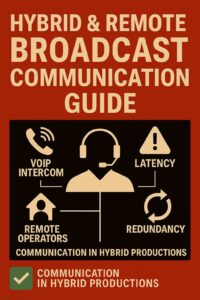
Modern live productions increasingly combine on‑site crews, remote operators, virtual guests, and directors working from different locations. Communication in hybrid and remote productions requires strict protocols to stay stable despite delays, inconsistent environments, and lack of visual contact.
- communication delays
- inconsistent technical environments
- lack of visual contact
- increased intercom load
- the need for strict protocols
This article outlines the essential communication principles that keep hybrid and remote productions stable, coordinated, and professional.
1. Core Types of Remote Communication
Hybrid productions typically rely on several parallel channels:
1. Internet‑based intercom (VoIP intercoms)
Examples:
- Unity Intercom
- Clear‑Com Agent‑IC
- Riedel Bolero (IP‑based setups)
Pros: flexible, scalable Cons: dependent on network stability
2. Video conferencing
Used for:
- remote guests
- remote directors
- remote graphics operators
3. Messaging apps
Used for:
- file transfers
- backup communication
- silent cues
4. Local walkie‑talkies
Still essential for assistants and mobile operators on site.
These channels form the backbone of communication in hybrid and remote productions.
2. Latency Challenges in Communication in Hybrid and Remote Productions
Latency is one of the biggest challenges in communication in hybrid and remote productions.
To minimize its impact:
- commands must be shorter than usual
- the director should speak slower and more clearly
- operators should confirm only critical commands
- transitions must be pre‑planned
If latency exceeds 300–400 ms, the workflow should shift to:
- predefined scenarios
- predictable operator behavior
- minimal real‑time corrections
3. Protocols for Remote Operators and Technicians
Remote team members must follow strict rules:
- fixed command structure
- mandatory pre‑show communication tests
- a backup channel (messenger or phone)
- predefined fallback actions
Examples of fallback actions:
- graphics operator automatically displays a safe slate if communication drops
- remote director switches to “monitor‑only mode” when latency spikes
4. Communication With Remote Hosts and Guests
Remote hosts are the most sensitive part of hybrid productions.
To ensure stability:
- IFB must be separate from the video call audio
- commands must be very short
- the host should have a local countdown timer
- the host must be briefed that latency is normal
For guests:
- use a virtual “green room”
- check audio and lighting beforehand
- keep a chat channel open for silent communication
5. The Technical Director’s Role in Hybrid Productions
The Technical Director (TD) becomes the system’s central router:
- monitors all communication channels
- tracks latency
- switches to backup lines
- coordinates remote and on‑site teams
- logs all technical events
In hybrid productions, the TD is the heart of the operation.
6. Safety and Redundancy
Remote productions require double redundancy:
- backup internet connection
- backup intercom
- backup power
- backup operator or director
- backup show scenario
If communication is completely lost:
- the on‑site team takes control
- remote participants switch to standby
- the broadcast moves to a safe segment
7. Post‑Show Review
After a hybrid broadcast, it’s essential to:
- measure latency
- identify weak network points
- update protocols
- refine fallback scenarios
- retest equipment
Hybrid productions evolve faster than any other format — and require constant adaptation.
Conclusion
Hybrid and remote productions are the future of the industry. But their success depends not on technology alone — it depends on how clearly communication is structured across all participants. Clear communication in hybrid and remote productions ensures that distance never becomes a barrier.
Series Index: Communication in Live Broadcast Production
- Communication in Live Broadcast Directing: How directors coordinate their teams in real time
- Communication Equipment for Live Broadcast Teams: From basic to professional intercom systems
- Director–Host Communication: Balancing Control and Flow: IFB, tone, timing, and on‑air guidance
- Working Under Pressure: Communication Protocols During Live Failures: Emergency commands, fallback actions, stress discipline
- The Psychology of Team Communication in Live Broadcast: Trust, emotional stability, rituals, and roles
- Field–Truck Communication: Ensuring Reliable Coordination: Stage management, mobile operators, safety
- Communication in Hybrid and Remote Productions: VoIP intercoms, latency, remote hosts, redundancy
- Multi‑Team, Multi‑Layer Broadcast Communication: Orchestrating complex productions with multiple crews
Reference source used while preparing this article on studfile.net.