
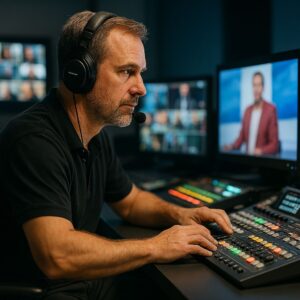
Live broadcast directing is a unique form of real‑time production where everything happens simultaneously — performance, camera work, audience reaction, and decision‑making. There are no retakes or post‑production safety nets, which makes the director’s role central to shaping the visual language, pacing, and overall viewer experience.
What a Live Broadcast Director Actually Does
The director is the command center of the entire stream. Their responsibilities include:
- building the visual structure of the broadcast
- switching cameras and choosing the best shot
- maintaining narrative logic and pacing
- coordinating operators, audio, graphics, and presenters
- making instant decisions under pressure
Unlike film, where editing occurs after shooting, live broadcast directing involves real-time editing. Every camera switch is a storytelling choice.
Core Responsibilities of a Live Broadcast Director
1. Designing the Visual Script
Even the most spontaneous live stream has a structure. A director prepares:
- segment breakdowns
- transitions
- shot lists for each block
- graphic elements
- interactive moments
This isn’t a rigid script — it’s a framework that keeps the broadcast coherent and predictable for the team.
2. Real‑Time Camera Switching and Live Editing
A multi‑camera setup is the backbone of any professional live stream. Directors work with:
- wide shots for orientation
- medium shots for dialogue
- close‑ups for emotion and emphasis
- technical or detail cameras for demos and inserts
Switching between these shots is what classic theory refers to as constructive editing — guiding the viewer through the story with intention.
3. Working With Hosts and Speakers
A director helps presenters:
- maintain pacing
- enter and exit segments smoothly
- understand which camera to address
- respond to cues
- keep the right emotional tone
In a live broadcast, the host is the face of the event, and the director is their navigator.
4. Managing Audio, Graphics, and External Sources
Modern live streams are more than just cameras. A director also oversees:
- presentations and screen shares
- remote guests
- video inserts
- lower thirds and titles
- animations
- chat and audience interaction
The director must see the entire puzzle and understand how each element fits into the flow.
Interactive Broadcasting: The New Standard
Traditional TV emphasized interactivity, but online streaming has taken it further.
Today, interactivity may include:
- live chat and Q&A
- polls and voting
- emoji reactions
- remote guest participation
- viewer‑selected camera angles
- personalized content blocks
A director must integrate these elements without breaking the rhythm of the broadcast.
Key Characteristics of Live Broadcast Directing
1. Simultaneity
Everything happens in real time.
There is no undo button.
The director must make decisions instantly.
2. Continuity
A live broadcast must feel seamless — no dead air, no awkward pauses, no visual confusion.
Even when something goes wrong, the director keeps the flow intact.
3. Psychological Stability
A director is the calmest person in the room.
They set the emotional tone for the entire crew and keep everyone focused.
4. Risk Management
Every live stream carries dozens of potential issues:
- audio dropouts
- remote guest freezes
- camera focus problems
- presenter mistakes
- missing graphics
A professional director always has Plan B, C, and D ready.
Conclusion
Live broadcast directing is a blend of technical expertise, artistic vision, and real‑time decision‑making. A great director must:
- think fast
- see the big picture
- guide presenters
- understand narrative structure
- integrate interactive elements
- manage risks gracefully
In modern streaming, the director is not just a person behind the switcher — they are the architect of the viewer experience.
Series Index: Communication in Live Broadcast Production
- Communication in Live Broadcast Directing: How directors coordinate their teams in real time
- Communication Equipment for Live Broadcast Teams: From basic to professional intercom systems
- Director–Host Communication: Balancing Control and Flow: IFB, tone, timing, and on‑air guidance
- Working Under Pressure: Communication Protocols During Live Failures: Emergency commands, fallback actions, stress discipline
- The Psychology of Team Communication in Live Broadcast: Trust, emotional stability, rituals, and roles
- Field–Truck Communication: Ensuring Reliable Coordination: Stage management, mobile operators, safety
- Communication in Hybrid and Remote Productions: VoIP intercoms, latency, remote hosts, redundancy
- Multi‑Team, Multi‑Layer Broadcast Communication: Orchestrating complex productions with multiple crews
Reference source used while preparing this article on studfile.net.