
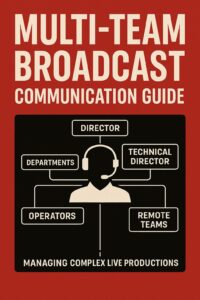
Modern live broadcasts rely on complex multi‑team broadcast communication systems. They are no longer handled by a single team or a single control room. Instead, they function as ecosystems where multiple groups operate simultaneously.
- several camera units
- lighting crew
- audio team
- graphics operators
- control room
- production truck
- remote participants
- social media stream crew
- backstage team
- engineering center
- producers and supervisors
Each group has its own tasks, communication channels, and internal dynamics. Yet all of them must function as one synchronized organism, without delays, conflicts, or chaos.
This article explores how communication is structured in such high‑complexity environments.
1. Multi‑Team Broadcast Communication: Multi‑Layered Command Structure
Large productions rely on a tiered communication hierarchy:
Level 1 — Director
Responsible for:
- creative vision
- pacing
- transitions
- host coordination
Level 2 — Technical Director (TD)
Responsible for:
- signal routing
- switching
- equipment stability
- redundancy
Level 3 — Department Supervisors
- camera supervisor
- audio supervisor
- graphics supervisor
- lighting supervisor
They receive commands from the director/TD and distribute them within their teams.
Level 4 — Operators and Crew
- camera operators
- assistants
- engineers
- floor crew
This hierarchy prevents overload and ensures clarity.
2. Segmented Channels in Multi‑Team Broadcast Communication
A single intercom channel is impossible in large productions. Instead, communication is split into dedicated channels, such as:
- Director → TD
- Director → Camera Supervisors
- TD → Engineering
- Stage Manager → Floor Crew
- Graphics → TD
- Audio → Director
- Remote Team → TD
Each channel has its own protocol, vocabulary, and priority level.
Such segmentation is essential for stable multi‑team broadcast communication.
3. Protocols for Parallel Broadcast Streams
When multiple streams run simultaneously:
- main broadcast
- backstage stream
- social media stream
- remote feed
- clean feed for post‑production
Communication must account for:
- different timelines
- different hosts
- different camera assignments
- different editorial goals
Example: While the main broadcast goes to commercial break, the backstage stream continues live, receiving its own set of commands that must not interfere with the main control room.
4. Managing Inter‑Team Conflicts
With many teams working at once, conflicts are inevitable:
- camera wants one thing
- audio wants another
- graphics has its own timing
- producers push for editorial changes
To avoid chaos:
- commands must flow top‑down only
- supervisors do not argue on comms
- disagreements are resolved after the show
- TD has the authority to make “hard decisions” regarding technical risks
Golden rule: Live broadcast is not a democracy — it is disciplined coordination.
5. Predictability as the Core of Stability
Large productions rely on predictability:
- standardized commands
- consistent transitions
- fixed start‑up rituals
- predefined fallback scenarios
Predictability reduces cognitive load and accelerates reaction time.
A clear hierarchy is the only way to maintain reliable multi‑team broadcast communication during high‑pressure moments.
6. Integrating Remote Teams Into Large Productions
Hybrid teams add complexity:
- latency
- time zone differences
- inconsistent technical setups
To maintain stability:
- remote teams receive their own communication channel
- strict protocols are enforced
- TD monitors latency
- director minimizes real‑time corrections
Remote teams must operate with higher discipline than on‑site teams.
7. Safety as a Communication Priority
In large productions, safety is not a separate topic — it is part of the communication protocol.
Priority commands include:
- “Stop movement!”
- “Cable underfoot!”
- “Operator, step back!”
- “Lighting, hold position!”
Safety commands override all other communication, including director cues.
8. Post‑Show Synchronization Across Teams
After a major production, it is essential to:
- gather supervisors
- review communication issues
- update protocols
- refine routing
- adjust responsibilities
- revise fallback scenarios
Large productions are living systems that evolve continuously.
Conclusion
A multi‑team broadcast is an orchestra. Each group plays its own part, but the performance works only when:
- roles are clear
- channels are separated
- protocols are unified
- commands flow top‑down
- TD and the director operate as a single brain
- the entire system is predictable and redundant
When all of this aligns, the broadcast becomes not only stable but beautiful.
This structure is what makes multi‑team broadcast communication predictable and efficient.
Series Index: Communication in Live Broadcast Production
- Communication in Live Broadcast Directing: How directors coordinate their teams in real time
- Communication Equipment for Live Broadcast Teams: From basic to professional intercom systems
- Director–Host Communication: Balancing Control and Flow: IFB, tone, timing, and on‑air guidance
- Working Under Pressure: Communication Protocols During Live Failures: Emergency commands, fallback actions, stress discipline
- The Psychology of Team Communication in Live Broadcast: Trust, emotional stability, rituals, and roles
- Field–Truck Communication: Ensuring Reliable Coordination: Stage management, mobile operators, safety
- Communication in Hybrid and Remote Productions: VoIP intercoms, latency, remote hosts, redundancy
- Multi‑Team, Multi‑Layer Broadcast Communication: Orchestrating complex productions with multiple crews
Reference source used while preparing this article on studfile.net.