
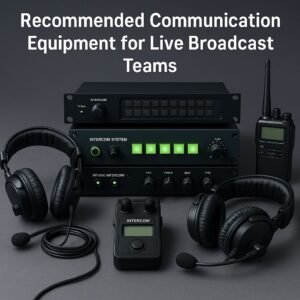
Effective communication is the backbone of any live broadcast team, and choosing the right communication equipment is essential for smooth production. The director’s ability to coordinate camera operators, audio engineers, graphics, and stage crew depends not only on clarity of commands but also on the reliability of the communication system. Below is an overview of the most commonly used communication equipment for live broadcast teams — from small streaming setups to full broadcast environments.
🟩 1. Entry‑Level Communication Solutions for Live Broadcast Teams (Small Teams, Schools, Basic Streaming)
These systems are ideal for small productions where mobility, simplicity, and affordability matter more than large-scale integration.
Unity Intercom (software-based)
A flexible, app-driven intercom system that runs on smartphones, tablets, and computers.
- Works over Wi‑Fi or mobile data
- Easy to deploy for remote teams
- Low cost of entry
- Ideal for small crews or hybrid setups
Hollyland Solidcom C1
A lightweight wireless intercom system designed for small to mid-sized teams.
- Hands‑free full‑duplex communication
- Simple setup
- Good range for indoor/outdoor use
- Comfortable headsets for long events
RØDE Wireless GO II / Wireless PRO (as improvised talkback)
Not a traditional intercom, but useful for small crews where only one or two operators need direction.
- Ultra‑portable
- Quick pairing
- Good audio clarity
- Works well for mobile camera operators
🟦 2. Mid‑Range Communication Equipment for Professional Live Broadcasts (Corporate Events, Conferences, Multi‑Camera Streams)
These systems offer more stability, scalability, and integration with production switchers.
Clear‑Com Encore / HelixNet
Industry-standard wired and digital intercom systems.
- Very low latency
- Reliable for long events
- Modular and expandable
- Suitable for medium-sized studios and event venues
Riedel Bolero S (entry configuration)
A compact version of Riedel’s flagship wireless system.
- Excellent audio quality
- Robust wireless performance
- Scales well as the team grows
- Ideal for mobile production units
Blackmagic ATEM Talkback (integrated)
For teams using ATEM switchers and Blackmagic cameras.
- Built‑in talkback over SDI
- Simple integration
- Good for camera operators
- Cost‑effective for ATEM-based workflows
🟧 3. High‑End Broadcast Systems (Television, Sports, Large Events)
These systems are designed for large crews, complex routing, and mission-critical reliability.
Riedel Bolero (full system)
A benchmark wireless intercom used in major international events.
- Exceptional clarity and range
- Highly scalable
- Used in sports broadcasts, concerts, and large TV productions
- Extremely reliable under heavy load
Clear‑Com FreeSpeak II
A hybrid wired/wireless system for large-scale productions.
- Supports dozens of users
- Excellent coverage in complex venues
- Flexible configuration
- Ideal for broadcast trucks and arenas
RTS ADAM Matrix + KP Panels
A classic matrix intercom system widely used in television.
- Highly configurable
- Panel-based workflow for directors and producers
- Rock-solid reliability
- Suitable for permanent installations and OB vans
🟨 4. Essential Accessories for Communication Systems
Professional Headsets
Clear communication depends heavily on headset quality.
- Sennheiser HMD 26 — broadcast standard for clarity and comfort
- Beyerdynamic DT 797 — robust and reliable for studio environments
- Clear‑Com CC‑300/400 — optimized for intercom systems
Tally Systems
Tally lights help operators know when their camera is live.
- Tally Arbiter (open-source)
- Blackmagic Tally
- Riedel Tally Control
Remote Communication Tools
Useful for hybrid or distributed teams.
- Unity Intercom
- Clear‑Com Agent‑IC
- Riedel Bolero Standalone
🟪 How to Choose the Right System
When selecting communication equipment, consider:
- Team size
- Venue layout
- Wired vs. wireless needs
- Integration with existing switchers/cameras
- Budget and scalability
- Remote vs. on‑site crew
A small streaming team may only need a software intercom, while larger productions require more advanced communication equipment for live broadcast teams.
Series Index: Communication in Live Broadcast Production
- Communication in Live Broadcast Directing: How directors coordinate their teams in real time
- Communication Equipment for Live Broadcast Teams: From basic to professional intercom systems
- Director–Host Communication: Balancing Control and Flow: IFB, tone, timing, and on‑air guidance
- Working Under Pressure: Communication Protocols During Live Failures: Emergency commands, fallback actions, stress discipline
- The Psychology of Team Communication in Live Broadcast: Trust, emotional stability, rituals, and roles
- Field–Truck Communication: Ensuring Reliable Coordination: Stage management, mobile operators, safety
- Communication in Hybrid and Remote Productions: VoIP intercoms, latency, remote hosts, redundancy
- Multi‑Team, Multi‑Layer Broadcast Communication: Orchestrating complex productions with multiple crews
Reference source used while preparing this article on studfile.net.