
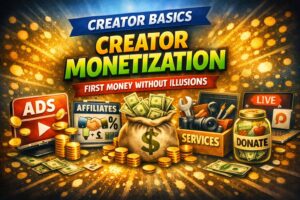
Creator monetization is not magic or fast income — it’s a system built on five streams: ads, affiliates, services, products, and donations. Understanding how creator monetization actually works helps you avoid illusions, burnout, and unrealistic expectations.
The Core Principle: Creator Monetization Is a Result, Not a Goal
Most beginners start with “How do I make money?” The real question is When does monetization make sense?
Monetization appears only when you have:
- consistent content
- a clear niche
- audience trust
- stable traffic
Your first money is not “passive income.” It’s a side effect of consistent work.
2. Ads: The Most Obvious, but Weakest Income Stream
Many assume ads are the main source of creator income. In reality, ads are the smallest and most unstable stream.
Pros
- automatic
- requires no extra work
- scales with views
Cons
- low RPM in most niches
- seasonal fluctuations
- depends heavily on audience geography
- platform can change rules anytime
Reality
- 1000 views = $0.3 to $5
- most channels earn closer to $1
- to live off ads, you need millions of monthly views
Ads are a bonus, not a strategy.
3. Affiliates: The First Real Money
Affiliate programs are the fastest way to earn, even with a small channel.
How it works
You recommend a product → someone buys → you get a commission.
Pros
- works with 500–1000 subscribers
- no need to create your own products
- integrates naturally into content
Cons
- requires honest recommendations
- can’t turn your channel into a storefront
- income varies month to month
Reality
Most creators earn their first $50–300 from affiliates.
4. Services: The Fastest Path to Bigger Income
If you have a skill, services provide the highest early income.
Examples
- editing
- consulting
- design
- scripting
- coaching
- technical help
Pros
- high rates
- fast to start
- works even with a tiny audience
Cons
- time‑bound
- hard to scale
- requires expertise
Reality
Services are how many creators earn their first $500–2000 while the channel grows.
Products: The Foundation of Long‑Term Creator Monetization
Products make your channel independent and stable.
Examples
- courses
- guides
- templates
- presets
- digital downloads
- merch
- mini‑apps
Pros
- scalable
- independent of algorithms
- high average revenue per customer
Cons
- requires time to build
- requires audience trust
- requires ongoing support
Reality
Products become the backbone of income after 10–20k subscribers.
6. Donations: Support, Not a Business Model
Donations are not a revenue engine — they are a relationship engine.
Formats
- Patreon
- YouTube Membership
- Boosty
- one‑time donations
- private communities
Pros
- stable support
- strong core audience
- space for exclusive content
Cons
- low income at the beginning
- requires consistent attention
Reality
Donations usually make up 5–15% of income but are emotionally important.
7. What Works for Small Channels
Up to 10,000 subscribers, the strongest streams are:
- affiliates
- services
- simple digital products
Ads and donations are secondary.
8. What Works for Mid‑Size Channels
From 10,000 to 100,000 subscribers:
- products
- affiliates
- ads
- collaborations
- donations
9. What Works for Large Channels
Above 100,000 subscribers:
- products
- sponsorships
- ads
- your own tools or services
- subscription models
- events
Conclusion: Creator Monetization Is a Strategy, Not a Hope
Monetization is not “when YouTube turns ads on.” It’s a system of five parallel income streams:
- ads — bonus
- affiliates — early income
- services — first big money
- products — long‑term stability
- donations — community support
When you understand the mechanics, the first money arrives naturally — without illusions and without disappointment.
Creator Basics: A Practical Guide for Beginner Video Makers
- Part 1: Starting a Video Channel: Only When You Can’t Not Do It
- Part 2: How to Choose Your Channel’s Topic and Style
- Part 3: Equipment for Beginner Video Creators
- Part 4: Light, Sound & Framing: Essential Visual Literacy for Beginner Creators
- Part 5: Tips for speaking on camera
- Part 6: Script & Structure: Hook → Value → Retention → CTA
- Part 7: Editing for Beginners
- Part 8: Content Plan & Publishing Discipline
- Part 9: How to Grow Your Channel: Algorithms, Tags, Thumbnails
- Part 10: First Money: Monetization Without Illusions (current article)
- Part 11: AI and the Collapse of Traditional Video Production: What Creators Need to Know in 2025–2030
The following Russian‑language articles served as foundational references while preparing this guide. They offer beginner‑level perspectives on starting a video channel and reflect common advice shared in early creator communities:
- “How to Become a Video Blogger: Tips for Beginners” — an overview of basic steps, early decisions, and common mistakes new creators face when starting a channel.
- “How to Become a Video Blogger: Advice for New Creators” — a short introduction to choosing a topic, preparing for on‑camera work, and understanding the psychological side of public content creation.
- “20 Useful Tips for Beginner Video Bloggers” — a practical list of recommendations focused on discipline, consistency, and the technical basics of filming and publishing videos.